DumagueteInfo Has Moved!
DumagueteInfo has a new home and you are viewing an archived article. Get the latest of what the new DumagueteInfo has to offer after reading this article. Thank you! Read more →
DumagueteInfo has a new home and you are viewing an archived article. Get the latest of what the new DumagueteInfo has to offer after reading this article. Thank you! Read more →
https://dumagueteinfo.com Thu, 17 May 2018 03:23:47 +0000 en-US hourly 1 https://wordpress.org/?v=4.9.6 Dumaguete Forums https://dumagueteinfo.com/dumaguete-city/forums/ https://dumagueteinfo.com/dumaguete-city/forums/#respond Mon, 18 May 2015 17:23:25 +0000 https://dumagueteinfo.com/?page_id=2501 Redirecting you to our forums.
Click Here if you do not want to wait.]]> https://dumagueteinfo.com/dumaguete-city/forums/feed/ 0 Pasay City: Cultural Center of Metro Manila https://dumagueteinfo.com/other-destinations/metro-manila/pasay-city/ https://dumagueteinfo.com/other-destinations/metro-manila/pasay-city/#respond Wed, 24 Sep 2014 02:42:00 +0000 https://dumagueteinfo.com/PhilippinesTravel/metro-manila/pasay-city/12/ Pasay City
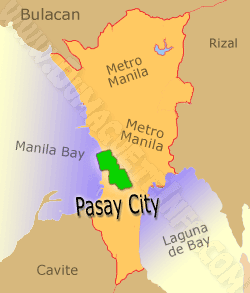 One of the four cities that originally comprised Metro Manila, Pasay is the third smallest city in the National Capital Region with an area of only 1,900 hectares. It is adjacent to the City of Manila and is bordered by the Manila Bay to the west, Makati and Taguig cities to the northeast and Paranaque City to the south.
Because of its close proximity to the City of Manila and access to Manila Bay, the city shares with the national capital a history and rich culture that dates back to pre-Hispanic times. Story has it that the city’s origin can be traced to the reign of Rajah Soliman who ruled Maynilad, a Muslim kingdom on the southern delta of the Pasig River. It is said that he married a Princess from Sumatra who bore him a son and a daughter—Prince Sowaboy and Princess Pasay. Prior to his death, Rajah Soliman divided his kingdom to his two heirs and the half that went to the princess was named Pasay.
Among the cities in Metro Manila, Pasay has the largest area earmarked and devoted to vital infrastructure and utilities. More half of its total land area, or 950 hectares, is occupied by Terminal 2 and Terminal 3 of the Ninoy Aquino International Airport, the Manila Domestic Airport and Villamor Airbase. The city proper covers only about one-fourth of its land area, or 550 hectares because the balance of 400 hectares represents the area reclaimed from Manila Bay where the imposing Cultural Center Complex (CCP) is located.
Pasay City is not known as the “Cultural Center of Metro Manila” for nothing because most of its attractions are at the CCP Complex. Located in this area which is devoted to the development and promotion of the arts, culture and trade are the Tanghalang Francisco Balagtas, Coconut Palace, Cultural Center of the Philippines, Manila Film Center, Philippine International Convention Center, World Trade Center-Metro Manila, Philippine Trade Training Center, Product Design and Development Center of the Philippines. The Cuneta Astrodome where sporting events and beauty pageants are held and theme parks such as Nayong Pilipino, Boom na Boom and Star City are located nearby. Popular destinations of visitors to Pasay are the following:
The Coconut Palace: Located along Eduardo A. Makabenta Street at the CCP Complex, this luxurious venue is a palace made of coconut lumber, coconut shells and various Philippine hardwood to celebrate the coconut as the “Tree of Life.” Literally every part of the coconut tree is used in the construction, design and ornaments of the Coconut Palace—from its trunk and roots to the bark, flower, fruit and shell.
Nayong Pilipino: Touted as the country’s one and only cultural park. Located along MIA Road, Nayong Pilipino presents the Philippines in miniature and showcases the rich cultural and natural heritage of the country through indigenous architectural styles, creative crafts, art and cultural presentations.
SM Mall of Asia: Located at the southernmost tip of EDSA inside the reclaimed area is the biggest shopping mall in the country and listed by Forbes magazine as the third largest in the world. Some of the main attractions the SM Mall of Asia are the first ever IMAX theater in the Philippines and an Olympic-sized skating rink, which is reputedly the biggest in Southeast Asia.
Cities that have so many attractions to offer like Pasay must be able to feed its multitude of visitors that flock to its tourist destinations every day. Restaurants, eateries and fast food chains in malls, tourist belts and cultural centers all compete for the attention and patronage of visitors: Among these are:
Singkit: Located at Harbor Square at the CCP Complex, this establishment offers authentic Chinese specialty food that is either delivered or served fresh and piping hot to dine-in patrons in charming take-out boxes, just like in New York. Popular orders are the classic chicken with quail eggs, mouth watering lechon Macau, the ubiquitous but sumptuous sweet and sour pork and yummy mixed vegetables and beef broccoli. A meal good for four people will cost a very reasonable P350.00.
Chef de Angelo: If you are into pasta, then this mid-range Italian restaurant is for you. Located on the 1st level at the Main Mall of the Mall of Asia, this joint offers salad, pizza and pasta. But if you are looking for a heavier meal, you can throw in an order for buffalo chicken wings priced at about P800.00 for an order good for five people.
Pink Pepper: Wrap up your visit with a gastronomical, albeit, a bit pricey experience at the Pink Pepper found at the Esplenade, Bayside at the Mall of Asia. An order of pepper steak with a dash of sweetish, mildly hot pink pepper after which this classy joint was named priced at around P430.00, or a nutritious salmon wrap costing P420.00 should not be eaten with your eyes shut to savor the food better, otherwise you will miss the golden splendor of the romantic Manila Bay sunset.
This metropolitan center of culture boasts of numerous hotel accommodations for visitors coming from all over the country and the throughout the world. These accommodations range from expensive elegant five-star hotels to unpretentious yet classy places for the budget conscious traveler. Examples are:
The Heritage Hotel: Located near the CCP Complex, theme parks and airport, this elegant place feature 467 tastefully appointed guest rooms that include coffee makers, complimentary newspapers and bottled water, cable TV, direct dial telephone, in-room safes and friendly, attentive staff. Room rates start at a hefty P5,635 for the visitor who want nothing but the best accommodations.
Website: http://www.millenniumhotels.com
Roxas Boulevard corner EDSA
Pasay City
Tel.No. +1 800 1 11 0782 (international)
Email: inquiry@heritagehotelmanila.com
Traders Hotel Manila: Located right in front of the Cultural Center of the Philippines, this mid-range hotel offers internet connectivity, coffee/ tea maker, IDD/ NDD telephone, in-room locker, cable/satellite TV, in-house movie channels and mini-bar.
Website: http://www.shangri-la.com/manila/traders/en/
3001 Roxas Blvd.
Pasay City
Tel. Nos. +63(2) 523-7011 to 20
Email: thm@shangri-la.com
Kabayan Hotel: Located at the Pasay Rotonda a spitting distance from the MRT station along EDSA, this budget hotel offers a secure, functional and convenient accommodation. With room rates starting at USD47.00, or P1,880.00 converted at current forex rates, this budget hotel offers air conditioned rooms, cable TV, bedside control panel, mini-bar, private toilet and bath.
Website: http://www.kabayanhotel.com.ph
2878 Zamora Stree corner EDSA
Pasay City
Tel. No. (632)891-6452; 831-5152
E-mail : info@kabayanhotel.com.ph
Manila to Pasay and Back: The Light Rail Transit (LRT-1) is the fastest and cheapest way to get from Manila to Pasay. From its station in Monumento, the LRT traverses the Rizal Avenue Ext. in Caloocan going to the City of Manila all the way up to Pasay City in less than thirty minutes for less than P30.00
Cebu to Pasay and Back: To reach Pasay from Cebu, you can either fly from Cebu to the Manila Domestic Airport in Pasay or sail from Cebu to Manila. Approximate cost of a round trip plane ticket is P4,000.00 – P5,000.00 while a round trip boat fare is approximately P3,000.00 – P4,000.00. If your point of disembarkation is the Pier Area in Manila, you can take a jeepney or cab to the LRT-1 station in Avenida Rizal and board the train going to Pasay. The taxi fare from the Pier Area to the LRT-1 station is about P100.00-P150.00, while the jeepney fare is cheaper at P7.50 (one way). The LRT train fare is less than P30.00.
Dumaguete to Pasay and Back: To reach Pasay from Dumaguete, you can fly from Dumaguete to the Manila Domestic Airport in Pasay. Approximate cost of a round trip plane ticket is P4,000.00 – P5,000.00.
]]> https://dumagueteinfo.com/other-destinations/metro-manila/pasay-city/feed/ 0 Las Piñas City: “Home of the Bamboo Organ” https://dumagueteinfo.com/other-destinations/metro-manila/las-pinas/ https://dumagueteinfo.com/other-destinations/metro-manila/las-pinas/#respond Sun, 21 Sep 2014 23:50:03 +0000 https://dumagueteinfo.com/PhilippinesTravel/metro-manila/las-pinas/15/ Las Piñas City
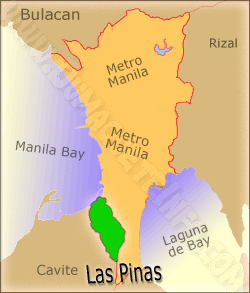 One of the earliest settlements in the coastal fringes of the old Walled City of Manila, Las Piñas City is bounded on the south and southwest by the municipalities of Imus and Bacoor in Cavite; on the north and northeast by Parañaque City; on the east and southeast by Muntinlupa City; and, on the northwest by the Manila Bay.
In 1775, this small fishing village was established into a town by the Spanish colonialists. During the Philippine Revolutionary War for Independence in 1896 Las Piñas was the site of numerous battles between the Katipunan and Spanish forces. There are quite a few schools of thought on the origin of the city’s name, but the most plausible is a theory based on an inscription on an old church bell dating back to the time of Fr. Diego Cera which shows that the town was then known as Las Peñas. The phrase “las peñas,” which means “the rocks,” referred most likely to the stones and adobe that were quarried in the area for the construction of bridges and buildings during those days. As the years went by, the phrase “las peñas” could have easily been corrupted to “las piñas” which is in use up to this day.
One cannot think about Las Piñas City without the world renowned Bamboo Organ coming to mind. Presently installed at the St. Joseph Church of the Parish of Las Piñas, this musical instrument made out of bamboo, wood and metal is the only organ of its kind in the world. It was built in 1824 by Fr. Diego Cera, the town’s first parish priest and is famous not only for the indigenous materials used in its construction, but for this unique instrument’s deep, melodious sound as well.
Las Piñas is a late bloomer, emerging from its rural cocoon in the late 60s with the construction of the South Super Highway. In the mid-80s, progress in this 4,154-hectare city went along at a faster clip when the Coastal Road was constructed directly linking Metro Manila to Cavite. By the early 90s, Las Piñas was serving as the gateway to the Cavite-Laguna-Batangas-Rizal-Quezon industrial growth corridor. Eventually, this once rustic coastal town transformed into a booming urban city of large industries and residential subdivisions. In 2002, it was named one of the country’s “Most Competitive Cities” together with Makati, Marikina, Muntinlupa and Davao cities.
Although Las Piñas City is 20 kilometers from the heart of the City of Manila, it has been swallowed up by the huge urban sprawl that is Metro Manila. Nonetheless, the city has kept its own individual character and remains to be the favored stop of visitors because of its attractions that are unique and distinctly Filipino.
The Bamboo Organ: This rare and unique musical instrument can be found inside the St, Joseph Church of the Parish of Las Piñas. Fr. Diego Cera, its first parish priest, constructed the organ in 1824 using hundreds of bamboo poles that he buried in the beach sand for one year so that these will resist termite infestations. The organ is admired not only for its construction, but for its melodious sound as well. Ancient though it is, the organ is still working and is still in use up to this day. That is why it becomes the center of attention when the city celebrates the Bamboo Organ Festival during the month of February which attracts many music artists all over the world.
Sarao Jeepney Factory: Dubbed as the “King of the Road,” the ubiquitous jeepneys that ply the roads of Metro Manila and in the provinces are a testament to the ingenuity of the Filipino. Las Piñas is the acknowledged jeepney producing center of the country, and the Sarao Jeepney Factory owned by Leonardo Sarao is the recognized pioneer and leader in the industry. Your trip to Metro Manila will not be complete without visiting this vehicle assembly plant located along Padre Diego Cera Ave., Pulanglupa to witness how these works of art on four wheels are made.
Salt Beds: The distinction “Salt Center of Metro Manila” used to be held by Las Piñas—until the construction of the Coastal Road and land reclamation project in Manila Bay severely affected the industry. However, through the initiatives of local government leaders, the salt beds of Las Piñas were restored giving visitors the chance to see the traditional method of salt-making and harvesting the way the people in this historic place have been doing it for the past two centuries.
While Las Piñas has retained some vestiges of its rural setting, it does not lack in modern facilities that would address the needs of its residents and visitors. Its modern malls are filled with recreational and food establishments where one can obtain reasonably priced food and entertainment, such as:
Dencio’s Bar and Grill: Located at the 2nd level of Star Mall Las Piñas along C.V. Starr Ave. in Pamplona, this food establishment provides excellent Filipino and grilled seafood and music entertainment at very reasonable prices.
Barrio Fiesta Restaurant: When you think of Filipino dishes, Barrio Fiesta invariably comes to mind. Luckily, this popular restaurant now has a branch at the 3rd level of SM Southmall located at Alabang-Zapote Road. So, when you are in the vicinity, why not check out its special kare-kare in thick peanut sauce served in an authentic bubbling palayok (earthen pot).
Ted’s La Paz Batchoy: If you want a quick, hot, filling meal why not step into this joint located at the Ground Level of SM Southmall. Order a large bowl of its extra super original La Paz batchoy and a plate of puto (rice cakes), then wash it down with a glass of ice cold tea. This heavy meal is guaranteed to keep you going for the rest of the day.
Balikbayan Vacation Home: Located in a middle class gated community, this B&B establishment is centrally located to the Alabang Town Center, Madrigal Business Center and has easy access to major road arteries leading to the Metro Manila and Calabarzon areas. It has two air conditioned rooms, one bathroom with hot water, cable TV, in-room ref, living room, dining room and well equipped kitchen. One of the bedrooms has a queen size bed and two single beds in the other. All these conveniences for a rate of USD50.00, or P2,000.00 converted at current forex rates.
23 Leo Street
Veraville Homes I Subdivision
Las Pinas, Philippines
Tel. No.: 951-698-0873 (US)
Toll Free: -011-639293442669(PH)
Eurotel: Provides the elegant service and ambiance of a European hotel at a cost you can afford. With rates starting at P1,975.00 guests will enjoy air conditioned rooms, wi-fi connection, bar and café, 24-hr. room service and free valet parking.
Website: http://www.eurotelph.com/index.htm
Alabang – Zapote Road (in front of SM Southmall)
Alamanza Uno, Las Piñas City
Tel: (63-2) 805-0095; 806-7646
Fax: (63-2) 800-3876
E-mail: eurotel_lp@yahoo.com
Manila to Las Piñas and Back: The Coastal Road that runs throughout the southern length of Metro Manila’s shoreline with Manila Bay is a very important artery for people commuting to and from Manila to Las Piñas and Cavite. You can get to Las Piñas on buses from Taft Avenue in Manila bound for Zapote or Cavite and just tell the conductor to inform you when to get off. Approximate bus fare will not exceed P50.00.
Cebu to Las Piñas and Back: To reach Las Piñas from Cebu, you can either fly from Cebu to the Manila Domestic Airport in Pasay or sail from Cebu to Manila. Approximate cost of a round trip plane ticket is P4,000.00 – P5,000.00 while a round trip boat fare is approximately P3,000.00 – P4,000.00. If your point of disembarkation is the Pier Area in Manila, you can take a jeepney or hop into a taxi cab and ask the driver to take you to Taft Avenue. From there take a bus bound for Zapote of Cavite. The taxi fare from the Pier Area to Taft Avenue is about P100.00-P150.00, while the jeepney fare is cheaper at P7.50. The bus fare to Las Piñas will not exceed P50.00. If your point of disembarkation is the Manila Domestic Airport, take a taxi cab up to Roxas Boulevard then board the bus bound for Zapote or Cavite. The taxi fare is about P100.00 while the bus fare to Las Piñas will not exceed P50.00.
Dumaguete to Las Piñas and Back: To reach Las Piñas from Dumaguete, you can fly from Dumaguete to the Manila Domestic Airport in Pasay. Approximate cost of a round trip plane ticket is P4,000.00 – P5,000.00. From the airport, hop on a taxi cab up to Roxas Boulevard and take the bus bound for Zapote or Cavite. The taxi fare is about P100.00 while the bus fare to Las Piñas will not exceed P50.00.
]]> https://dumagueteinfo.com/other-destinations/metro-manila/las-pinas/feed/ 0 Muntinlupa: Emerald City of the Philippines https://dumagueteinfo.com/other-destinations/metro-manila/muntinlupa/ https://dumagueteinfo.com/other-destinations/metro-manila/muntinlupa/#comments Sun, 21 Sep 2014 23:50:03 +0000 https://dumagueteinfo.com/PhilippinesTravel/metro-manila/muntinlupa/17/ Muntinlupa
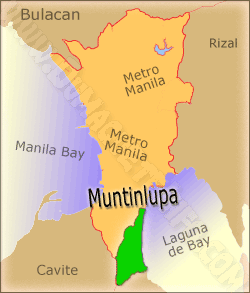 What was once an agricultural town mostly devoted to cow pasture has metamorphosed into the new residential haven of Metro Manila. Muntinlupa is the southernmost city of Metro Manila bounded on the east by Laguna de Bay; on the southwest by the provinces of Laguna and Cavite; on the west by Las Piñas; on the northwest by Parañaque; and, on the north by Taguig City.
Owing to its general topography, which is somewhat hilly, this tiny poblacion was referred to by its inhabitants during the Spanish period as “monted de lupa,” a vernacular phrase meaning “hills” from which, many believed the name of Muntinlupa originated. Just a few decades ago, this place was at the receiving end of unfair jokes and bad press and has earned undue notoriety. The mere mention of the word “Muntinlupa” always brought to mind the chilling image of the New Bilibid Prison which is located within its jurisdiction. However, palpable progress has a way of changing for the better negative impressions created by the stigma of it being the home of hardened criminals.
During the last decade, the city has undergone rapid development particularly in its Alabang district. The Filinvest Corporate City and the Madrigal Business Center District which host the biggest and swankiest residential communities and business establishments have changed the face of Muntinlupa from a once sleepy town to a bustling modern metropolis. Some of the wealthiest and famous personalities that live in these classy villages include a former Philippine president, well-known show biz celebrities and even the prince of an oil-producing nation. Recently, it received the status of “Most Competitive and Improved City.” Like a precious stone plucked from the mining quarry in its raw form, then cut and polished to perfection, Muntinlupa City—the new glistening jewel of Metro Manila, is now referred to as the Emerald City of the Philippines.
Muntinlupa boasts of the Ayala Alabang Village which is the largest and cleanest exclusive residential subdivision in the country; Alabang Town Center along the Ayala-Alabang-Zapote Road; Festival Mall at the Filinvest Corporate City; and, Manuela Metropolis below the South Super Highway Flyover which are considered as some of the largest malls in the country that feature indoor theme parks.
Visitors who believe that the things to see in a modern city like Muntinlupa that has recently emerged from rural obscurity can only be found in its modern commercial districts and plush residential subdivisions. But for the more adventurous and curious visitor who had seen enough of modern malls and plush villages, the unique spots that define the city’s character and its past may prove a more interesting justification for their trip.
Ironically, this once-in-a-lifetime sightseeing experience can be found at the very place that has given the city its past notoriety—The New Bilibid Prison located at Barangay Poblacion. Hidden within the grounds of this sprawling 530–hectare state penitentiary reservation complex which is surprisingly peaceful and safe, are the following attractions?
Jamboree Lake: Said to be the country’s smallest natural lake, whose water and surrounding park are surprisingly clean.
Monument Hill: Located a few meters from the lakeshore is a mound with a cross that serves as the marker for the resting place of Eriberto Misa, a prison director during World War II who made a mark in history by initiating programs that made prison life more bearable.
Yamashita Shrine: A burial site for Japanese soldiers killed during World War II. General Tomoyuki Yamashita, the “Tiger of Malaya,” is said to have been buried in this place after he was executed for war crimes committed by Japanese troops in World War II.
The best places to visit whenever you feel the urge to go on a shopping spree or a food trip are the modern and comfortable malls of Muntinlupa.
Gerry’s Grill: Located at Alabang Town Center, this food establishment is just the perfect place for the visitor who loves to feast on freshly grilled or cooked food on a budget of P200.00 per meal.
Cabalen: This restaurant can be found at the 3rd Floor of the Festival Mall. It features food from Pampanga like its famous native sausages and processed meats at a mid-range cost of P300.00 per meal. If you feel up to it, try its exotic snails cooked in coconut milk. A pricey appetizer in French cuisine cooked with garlic and parsley butter with an equally pricey sounding name—“escargot,” which simply means snail is very popular in European and North American fine dining. You can eat this delicacy with an Asian twist for a fraction of the cost at Cabalen.
Red Crab Seafood and Steaks: For P500.00 per meal, you can stuff yourself with its crowd drawer—different crab dishes cooked just right to tickle your taste buds from hot to gingery sweet and spicy flavors. A culinary experience to remember for first time visitors of this establishment located at the 2nd level, Cortes de las Palmas along Alabang-Zapote Road.
Parque España Residence Hotel: Whether you are a well-traveled businessman or a leisure traveler, you will definitely fine in this hotel all the comforts, warmth and security which will make you feel that you have never left home at all. For a starting rate of USD70.00, or P2,800.00 converted at the prevailing forex rates, visitors will enjoy living and dining areas with complete dining facilities, cable TV, kitchen with complete cooking facilities, IDD/NDD telephone, broadband internet connectivity, mini bar and hot and cold shower.
Website: http://www.parqueespana-alabang.com/index.htm
5309 East Asia Drive, Filinvest Corporate City, Alabang
Muntinlupa City 1781, Philippines
Tel. Nos.: (632) 850-5847
Fax Nos.: (632) 850-5660
Email address: parqueespana@hii.com.ph
Vivere Suites: Every room in this mid-range hotel features Asian elegance designed to provide for your comfort and convenience. Starting at USD120.00, or P4,800.00 converted at prevailing forex rates, each standard room is equipped with a living, dining and kitchen area aside from the usual bathroom and bedroom.
5102 Bridgeway Avenue
Filinvest Corporate City
Alabang, Muntinlupa City
Tel.No.: (632) 771-7777
Fax No.: (632) 771-0158
The Bellevue Manila: Located at the plush Filinvest Corporate City, this high rise hotel offers a wide range of recreational facilities and a fully equipped business center to meet the needs of both the leisure and business travelers. With rates starting at USD179.00.or P7,160.00 converted at current exchange rates, this 222 room high rise provides in-room fax, in-house movies, broadband internet connection, air-conditioning, telephone, mini bar, room safe, satellite TV, voice mail and tea/ coffee maker.
Website: www.thebellevue.com.ph
North Bridgeway, NorthGate
Cyberzone, Filinvest Corporate City
Alabang, Muntinlupa City
Tel. No.: 771-8181
Fax No.: 771-8282
Manila to Muntinlupa and Back: Air-conditioned and non air-conditioned buses ply the South Luzon Expressway (SLEX), which is the major route going to Muntinlupa City. Coming from Manila, you can catch the bus at the Taft Avenue corner Buendia Avenue station. Ask the bus conductor to remind you to get off the bus when it reaches Alabang. Traffic is sometimes very heavy at the SLEX and the trip could take about two hours. The bus ride should not cost more than P100.00.
Cebu to Muntinlupa and Back: To reach Muntinlupa from Cebu, you can either fly from Cebu to the Manila Domestic Airport in Pasay or sail from Cebu to Manila. Approximate cost of a round trip plane ticket is P4,000.00 – P5,000.00 while a round trip boat fare is approximately P3,000.00 – P4,000.00. From your point of disembarkation, you can take a jeepney or taxi cab to the bus station in Taft Avenue corner Buendia Avenue and board the bus bound for Cabuyao, Laguna and ask the bus conductor to let you off at Alabang. The taxi fare to the bus station costs about P250.00-P300.00 while the bus trip should not cost more than P100.00.
Dumaguete to Muntinlupa and Back: To reach Muntinlupa from Dumaguete, you can fly from Dumaguete to the Manila Domestic Airport in Pasay. Approximate cost of a round trip plane ticket is P4,000.00 – P5,000.00. From the airport, you can take a taxi cab to the bus station in Taft Avenue corner Buendia Avenue and board the bus bound for Cabuyao, Laguna and ask the bus conductor to let you off at Alabang. The taxi fare to the bus station costs about P250.00-P300.00 while the bus trip should not cost more than P100.00.
]]> https://dumagueteinfo.com/other-destinations/metro-manila/muntinlupa/feed/ 1 Manila: Pearl of the Orient https://dumagueteinfo.com/other-destinations/metro-manila/manila/ https://dumagueteinfo.com/other-destinations/metro-manila/manila/#respond Sun, 21 Sep 2014 11:16:37 +0000 https://dumagueteinfo.com/PhilippinesTravel/metro-manila/manila/9/ Manila
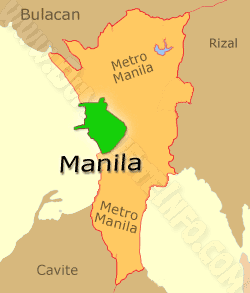 Located on the eastern shore of Manila Bay, bisected right in the middle by the mighty Pasig River just west of Quezon City on the island of Luzon, Manila is the chief seaport and cultural center of the Philippines. This 3,855-hectare land is the country’s seat of political and administrative power as it is the home of Malacanang Palace, the official residence of the President of the Philippine Republic, the Supreme Court and other major government agencies.
The city’s name is derived from the phrase “May Nilad,” which literally translates to “the place of the nilad,” referring to the flowering mangrove plant that grew in abundance centuries ago on the marshy shores of Manila Bay. Even in Pre-Hispanic times, this ancient city traded with India and China as it was once a part of two powerful Hindu empires, the Srivijaya that ruled Sumatra, and later, the Majapahit empire based in East Java.
Starting from the country’s colonial period in 1565 up to its independence in 1946, the city was the center of government by a succession of Spanish and American colonizers and Japanese invaders. Up until the start of the Second World War, Manila was considered the most beautiful city in Asia. But this distinction was abruptly put to an end when carpet bombing by U.S. Forces and house-to-house fighting leveled the city to the ground and made it the most ravaged city in the world second only to Warsaw in Poland.
Although the Philippines is said to be the largest Catholic country in Asia, Manila’s cosmopolitan culture mirrors a society that has held on to its roots. It has a mixture of different religions such as Muslims, Hindus and Christians that live together in harmony. This premiere city’s stature as the capital of the Philippines is globally recognized as Paris is widely known as the capital of France.
The City Seal of Manila, which shows a pearl embedded in a shell aptly describes the city as the “Pearl of the Orient” because of its picturesque location and astounding golden sunsets viewed from the shores of enchanting Manila Bay.
On account of its strategic location, this modern, teeming metropolis is used as a base for further travel to other parts of the country that is why it is often referred to as the “Gateway to the Philippines.” However, many people who stop to explore the city on their way to other parts of the islands discover the friendliness and charm of its blend of cultures, and invariably find nuggets of treasured sights to behold and experiences to remember. Manila is an exciting place to be and communication with its friendly people is easy because English is widely spoken, prices are dirt cheap and you can definitely get much more than your fair share of sunshine. A visit to Manila can never be complete without a tour of the following:
The Walled City of Intramuros: Located south of the Pasig River along Sta. Clara Street, this ancient fortress built by the Spanish colonizers in 1571 is the old and original enclave of Manila, which was the exclusive preserve of the Spanish ruling class. One of the oldest spots in the country, Intramuros is packed with ancient churches and buildings. The walls are almost what remained of the original fortress after the devastation of World War II. And, if you walk on its 4.5 kilometer long rampart, you can almost feel a strong sense of its glorious history.
Rizal Park: Said to be Asia’s largest park, this 60-hectare expanse of ornamental gardens, paved walks, open lawns, and wooded areas, is bordered by Burgos Street, Taft Avenue, T.M. Kalaw and Quirino Streets. The most familiar spot in this historically significant park is the monument of Jose Rizal, the Philippine National Hero, who was executed on this site by the Spanish colonialists, and where his remains now lie buried. Other attractions in the park are the National Museum,** the Planetarium**, Orchidarium, the Butterfly Pavilion, the Chinese and Japanese Gardens. Hundreds of locals and tourists alike flock here daily for a relaxing early morning or late afternoon stroll or to go people watching.
Ermita-Malate Tourist Belt: The Ermita and Malate Districts located south of the Pasig River are the centers of bohemian nightlife and are two of the city’s most well-known tourist districts known for night entertainment. In this area, tourists can also shop till they drop in the daytime for priceless souvenir items such as indigenous and tribal products crafted from fabric, wood, shells, silver, leather and other handicrafts and elegant embroidered products. The more adventurous bargain hunters can go to a cluster of stalls located under the Quezon Bridge in the Quiapo District north of the Pasig River where native handicrafts are sold at rock-bottom prices.
The historic past of the city is reflected on its blend of flavors and cuisine–from American to Spanish, Chinese and Japanese recipes, with specialties ranging from steaks to seafood and noodles. Understandably, the best Spanish food in the Far East can be found in Manila, the Philippines being the only former Spanish colony in Asia. However, a host of American fast food chains also dot the city such as Burger King, McDonald’s, Taco Bell, Wendy’s, Dairy Queen, Pizza Hut, KrispyKreme, Shakey’s and Kentucky Fried Chicken. Chow King (Chinese), Saisaki (Japanese) and Jollibee, the Filipino version of McDonald’s are found in most malls, tourist and university belts. A typical burger or chicken meal in these fast food chains can be had for as cheap as USD2.00 – USD3.00, or P80.00 –P120.00!
On the other hand, casual or sit-down dining in city restaurants fall under the mid-range price category, which amount to about USD8.00-USD10.00, or about P320.00-P400.00 per person. For this price range, you can also eat all you can buffet style in some of the city restaurants.
Ilustrado: Located in 744 Gen. Luna St. in Intramuros, this mid-range restaurant is set in a reconstructed Spanish-era house in the historic Walled City of Intramuros. European, Spanish and Filipino food are elaborately prepared and served here.
Harbor View: This establishment can be found at South Boulevard, in historic Rizal Park. Dining here is complemented by the clean, fresh sea breeze because the restaurant is located on a jetty fronting Manila Bay, which gives the illusion of dining aboard a yacht that is cruising on the bay.
Because people from all over the country and around the world flock to Manila all year round, there are all sorts of hotels and resorts in the city that cater to all levels of visitors. Most of these are conveniently located near tourist attractions and commercial centers.
Friendlys Guesthouse: This hostel offers good clean accommodation aimed at backpackers and budget conscious travelers. It has large living areas, a big kitchen and free wi-fi. Big Bed Aircon Rooms With Private Bath – P800.00, Triple Economy Double Deck Aircon Rooms (sofa bed on bottom and single bed on top for 3 persons) – P800.00, Big Bed / Double Deck Bed Aircon Rooms – P700.00, Aircon Dormitory – P300.00, Single Bed / Big Bed Fan Rooms – P400.00, 450.00 & 500.00.
Website: http://www.friendlysguesthouse.com
1750 Adriatico cor. Nakpil Streets
Malate, Manila
+632-0917-333-1418
Lotus Garden Suites: This hotel is emerging as one of the most preferred standard hotels in Manila, whose best rates of USD33.00, or P1,320.00 is just right for the visitor looking for mid-range cost accommodations.
Website: http://www.citygardenhotels.com
1227 A. Mabini cor. Padre Faura Streets
Ermita, Manila
+632-522-1515
Fax: +632-522-0768
The Manila Hotel: Located right beside the Rizal Park a short distance away from the Walled City of Intramuros and the Baywalk area, this historic hotel will surely fit the budget of visitors who love to splurge for a taste of class.
Website: http://www.manila-hotel.com.ph
One Rizal Park
Roxas Boulevard, Manila
+632-527-0011
Fax: +632-527-0022
How to Go Around the City: Public transportation like buses, jeepneys and taxi cabs are aplenty in the city. To avoid the nightmarish city traffic, you can ride the Light Rail Transit (LRT), whose two elevated lines run from Monumento in Caloocan City to Baclaran in Pasay City and from C.M. Recto in Manila to Santolan Avenue in Quezon City. Going around the city entails the minimum fare for a jeepney or bus ride. In addition, horse drawn carriages called “calesas” are popular means of transportations in certain areas, such as Intramuros, Rizal Park and Chinatown in Binondo.
Cebu to Manila and Back: To reach Manila from Cebu, you can either fly or sail from Cebu to Manila. Approximate cost of a round trip plane ticket is P3,500.00 – P5,000.00 while a round trip boat fare is approximately P3,000.00 – P4,000.00. After you disembark at the Manila Domestic Airport or Pier area, you can take a cab, which will cost about P150.00 to P250.00 (one way). If you are not in a hurry, from your point of disembarkation, you can hop on a bus, jeepney or LRT which will take you to Manila for less than P30.00 (one way).
Dumaguete to Manila and Back: To reach Manila from Dumaguete, you can fly from Dumaguete to Manila. Approximate cost of a round trip plane ticket is P3,500.00 – P5,000.00. After you disembark at the Manila Domestic Airport, you can take a cab to Manila, which will cost about P150.00 to P250.00 (one way). But if you have less money and more time to spend, you can hop on a bus, jeepney or MRT which will take you to Manila for less than P30.00 (one way).
]]> https://dumagueteinfo.com/other-destinations/metro-manila/manila/feed/ 0 Mandaluyong: “The New Tiger City of Metro Manila” https://dumagueteinfo.com/other-destinations/metro-manila/mandaluyong/ https://dumagueteinfo.com/other-destinations/metro-manila/mandaluyong/#respond Sun, 21 Sep 2014 03:00:14 +0000 https://dumagueteinfo.com/PhilippinesTravel/metro-manila/mandaluyong/14/ Mandaluyong
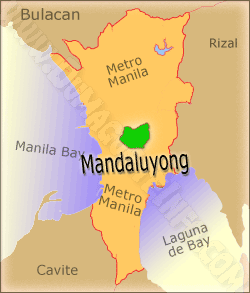 Lying on a 2,600-hectare heart-shaped piece of land, Mandaluyong is located just seven kilometers southeast of the City of Manila and eight kilometers west of Pasig City. It is bordered to the northeast by Quezon City, to the south by Makati City and to the northwest by San Juan.
In 1300 A.D., this place used to form part of the Kingdom of Sapa of the Majapahit Empire based in East Java. In 1470, it expanded to become the Kingdom of Namayan, whose influence extended to most of the 17 cities and municipalities that comprise Metro Manila today. Mandaluyong was formally established by the Spanish colonists in 1841 and named as the town of San Felipe Neri in honor of the Patron Saint of Rome.
Mandaluyong ostensibly got its present name from its rolling terrain and tall cogon grasses that sway in the wind like giant waves, or ‘daluyong’ in the vernacular. When asked where they live, natives to the place often referred to their small town as “madaluyong,” which literally translates to “place of many waves.” In due time, the word was corrupted to Mandaluyong, which stuck long after the little town’s rolling terrain and tall cogon grasses gave way to a glittering glass, steel and concrete jungle of high rise office buildings, modern residential condominiums, maze of paved streets, de luxe hotels and commercial centers.
Because it lies in the middle of the ‘Golden Triangle’ of Makati, Manila and Quezon City and straddles Metro Manila’s economic beltway that is EDSA, Mandaluyong underwent unprecedented growth and progress during the last decade. From a once sleepy town, it has transformed into an important industrial and residential area and was named in 2002 as the “New Tiger of Metro Manila” by the Department of Trade and Industry and the Asian Institute of Management Policy Center.
The city has several man-made places that will certainly be of interest to visitors and tourists alike. These include religious structures, monuments and memorials, government institutions and ultra modern commercial centers.
Ortigas Center: This center of business and commerce is one of the most popular attractions of Mandaluyong. Major international institutions and multinational companies, de luxe hotels and modern malls can be found here, such as: the main headquarters of the Asian Development Bank; San Miguel Corporation, the biggest food and beverage company in the Far East; St. Francis Towers; EDSA Shangri-la Manila; SM Megamall, one of the largest malls in Asia; Shangri-la Plaza; EDSA Central; and, Star Mall.
Mandaluyong City Hall Complex: Within this complex can be found the City Hall, a park where citizens take their daily stroll to relax, various monuments dedicated to the country’s heroes and a museum and convention hall that houses historical collections.
San Felipe Neri Church: Located at the corner of Rev. G. Aglipay and Boni Avenues, this ancient place of worship is dedicated to the Patron Saint of Rome after which Mandaluyong was named during the Spanish period. This heritage site which was run by hostile Spanish friars was a mute witness to bloody skirmishes between Katipunan patriots and the Spanish Guardia Civil.
You’ll never run out of places to eat when you are in Ortigas Center, which is frequented by professionals and executives working in the nearby high-rise offices. The following are the places that have become popular to mall habitués due to their culinary excellence, affordable prices or both.
Asian Bites: Located at the ground floor of the Robinson’s Galleria Supermarket, the counter for this food joint is very easy to find. This place has become very popular among many visitors who are looking for a cheap but filling meal, fast food style. If you want a quick hot meal, try its Asian dishes like noodles, mix vegetables, maki, sushi, tofu, gyoza and watch the cooks prepare your orders in their open-style kitchen as you sip on a glass of thirst-quenching iced tea. For only P100.00, you can enjoy a hearty meal of yakisoba and California maki.
Via Mare: This well-known restaurant that specializes in appetizing Filipino food is located at the ground floor of the Shangri-la EDSA. The cost of a decent meal is about average compared with other restaurants of its class in the vicinity.
Crustasia: Located on the third floor of The Podium along ADB Avenue, this establishment offers freshly caught crabs and seafoods. The ambiance exudes that elegant oriental air. While the menu is a bit pricey, perhaps, you’d like to try its steamed kingfish, grilled squid or crab maritess taken with a steaming platter of salted fried rice which would cost anywhere from P400.00 to P800.00.
Visitors who wish to stay overnight or for a few days are assured of availability of world-class hotels.
New Horizon Hotel: A European hotel that offers high-quality accommodations, services, facilities and lodging amenities at very reasonable cost. With rates starting at USD45.00, or P1,800.00 converted at present forex rates, guests will be entitled to air conditioned rooms, cable TV, IDD/NDD telephone, in-room personal safe and valet parking.
Website: http://www.newhorizonhotel-manila.com/Horizon EDSA Hotel
778 Boni Avenue, Mandaluyong City
Tel. (63+2) 532-3021 to 25
Richville Hotel: This hotel is situated within walking distance of the city’s commercial, financial and entertainment centers. With rates starting at P2,400.00, guests will enjoy large standard air conditioned rooms featuring cable TV, a huge bathroom and IDD/NDD telephone.
Website: http://www.richvillehotel.net/
286 EDSA Crossing
Mandaluyong City
Tel. No.: (+632) 533 – 7080
Cell Nos.: (+63919) 423-5455; (+63927) 886 – 1221
E-Mail: richville@philonline.com.ph
The Legend Hotel: Located within the EDSA-Pioneer business area, this 118-room hotel provides a place for business and leisure in a resort setting. With rates starting at P2,970.00, guests will enjoy an air conditioned room, queen-size bed, bedside control panel, cable TV, 2 IDD phone lines with internet access, toilet and bath and a mini bar.
Website: http://www.legendvillas.com.ph/
Pioneer St. cor. Madison St.
Mandaluyong City
Tel. Nos.: (63+2) 633-1501 to 05
Manila to Mandaluyong and Back: The Metro Rail Transit (MRT) is the fastest and cheapest way to get from Manila to Mandaluyong. At the MRT station in C.M. Recto Avenue, hop into a train going to Quezon City and alight at the MRT station in Cubao where you will hop into another train bound for Makati. Then get off at the MRT station in Shaw Blvd. in Mandaluyong. The entire trip should take less than one hour and will cost less than P50.00.
Cebu to Mandaluyong and Back: To reach Mandaluyong from Cebu, you can either fly from Cebu to the Manila Domestic Airport in Pasay or sail from Cebu to Manila. Approximate cost of a round trip plane ticket is P4,000.00 – P5,000.00 while a round trip boat fare is approximately P3,000.00 – P4,000.00. If your point of disembarkation is the Manila Domestic Airport, you can take a taxi cab or jeepney to the MRT station in Baclaran and board the train going to the Shaw Blvd. station in Mandaluyong. If your point of disembarkation is the Pier Area in Manila, you can take a jeepney or cab to the LRT-1 station in Avenida Rizal and board the train going to Baclaran in Parañaque. From there, board the MRT going to Shaw Blvd. station in Mandaluyong. The taxi fare from the Pier Area to the LRT-1 station is about P100.00-P150.00, while the jeepney fare is cheaper at P7.50 (one way). The LRT and MRT train fare is less than P50.00.
Dumaguete to Mandaluyong and Back: To reach Mandaluyong from Dumaguete, you can fly from Dumaguete to the Manila Domestic Airport in Pasay. Take a taxi cab or a jeepney to the MRT station in Baclaran and board the train going to Shaw Blvd. in Mandaluyong. Approximate cost of a round trip plane ticket is P4,000.00 – P5,000.00. The Taxi fare will cost about P150.00 while the train ride to Mandaluyong is less than P30.00.
]]> https://dumagueteinfo.com/other-destinations/metro-manila/mandaluyong/feed/ 0 Quezon City: “Hollywood of the Philippines” https://dumagueteinfo.com/other-destinations/metro-manila/quezon-city/ https://dumagueteinfo.com/other-destinations/metro-manila/quezon-city/#respond Fri, 19 Sep 2014 17:26:30 +0000 https://dumagueteinfo.com/PhilippinesTravel/metro-manila/quezon-city/7/ Quezon City: “Hollywood of the Philippines”
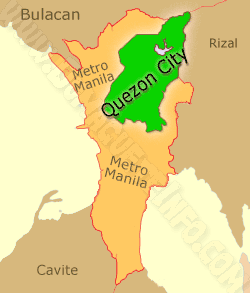 A sprawling land of 16,620 hectares of gently rolling hills straddling the Guadalupe plateau, Quezon City comprises the biggest portion of Metro Manila and is the second largest city in the country next to Davao City in Mindanao. It is bounded by the City of Manila on the southwest; Marikina and Pasig cities on the southeast; San Juan and Mandaluyong cities on the south; and, Caloocan and Valenzuela cities on the west and nortwest. Just across the Marilao River, lies San Jose del Monte City in the Province of Bulacan and to the east are the Municipalities of Rodriguez and San Mateo in the Province of Rizal.
Few would perhaps argue that it was here where the Filipino nation state was born. Barangay Bahay Toro in the Tandang Sora District of this wide expanse of rolling hills is the historic site of the “Cry of Pugad Lawin.” This was a defining moment in Philippine history when a thousand Katipunan patriots led by Andres Bonifacio declared on August 23, 1896 their rebellion against the Spanish colonial government. It was perhaps because of this milestone in its journey from colony to sovereign nation that one great Filipino leader dreamed of building the country’s capital city on these hills. The Quezon City Charter lapsed into law on October 12, 1939, and on July 17, 1948, it was proclaimed by Republic Act No. 333 as the capital of the Philippines–finally fulfilling the dream of President Manuel L. Quezon, in whose honor the city was named. But twenty-eight years later, on June 24, 1976, President Ferdinand Marcos declared the City of Manila as the new capital city by virtue of Presidential Decree No. 940.
In the ensuing years, the verdant pastures and rolling hills gradually gave way to multi-storey buildings, tree-lined boulevards, spacious parks, entertainment centers and commercial areas popular with shoppers all over the metropolis. More than half of the city’s total land area had been developed for residential purposes. This modern metropolis was dubbed as “The Hollywood of the Philippines” because of its distinction of being the enclave of TV and broadcast networks and film companies that churn out TV shows, movies and music.
Because it is categorized as a highly urbanized city, no one would ever imagine that this modern neon-lighted metropolis would harbor a slice of Nature right in its bosom. Situated near the Quezon Memorial Circle is the Ninoy Aquino Parks and Wildlife Nature Center, an 80-hectare complex of forest cover, lagoon, mini zoo, craft village and a fishing village. The various specimens of flora and fauna including the world famous monkey-eating eagle will certainly appeal to the nature tripper in you.
But what is particularly interesting about Quezon City is its people. While it has a cosmopolitan culture, lifestyle is surprisingly fresh, easy and warm, and not quite what would be expected of the usual elite urban setting where the social temperament is more reserved and laid back.
What better way is there for first time visitors than to get to know the paradox of urbanites with rustic charm. So, toss your cares away; let your hair down and meet people; take walks around the city; explore its huge malls; go to nearby cafes and bars where young professionals flock to relax and enjoy the vibrant nightlife; and, be hip in its tourist belts. Up close and personal, you will view both the people and the city through rose-colored glasses and love every minute of it. You can best see and do all these at the following places:
Eastwood City Business Center: It is one of the country’s newest and spankiest commercial area located along the southeasthern corner of the city in the Libis District. Be sure to be here starting at dusk to witness the serious businesslike mood magically transform into a jovial, care-free atmosphere. The open air restaurants and coffee shops are great venues for drinking and dining al fresco among the imposing office and residential skyscrapers while listening to outdoor band music.
Tomas Morato-West-Timog-Quezon Avenue Tourist Belt: This cluster of avenues in the Kamuning District is known for its night entertainment. Disco houses, night clubs, karaoke joints, and elegant restaurants are all found here. If you are the adventurous type looking for novelty entertainment, try Zirkoh or Klownz along the Quezon Avenue stretch. These popular comedy bars are co-owned by showbiz personalities Allan K, Ai-Ai de Las Alas and others who sing on stage, run gags, interview, rib and make fun of people in the audience, and ask them to come up on stage and sing with them. Visit these joints with one caveat—remember not to take the jokes and ribbing personally, because these are done in good humor and spirit.
Araneta Center: Located in the Cubao District, this busy area that is often compared to Madison Square in New York City is the focal point of business activities in the city. Clustered here are all kinds of establishments that you can imagine like gigantic supermarkets and department stores, novelty boutiques, restaurants, theaters, banks and other financial institutions. Some of the biggest and spankiest malls and stores can be found here such as Gateway, Ali Mall, Farmer’s Plaza, Rustan’s and Shopwise. At the heart of this commercial complex is the famous “Big Dome,” the Araneta Coliseum.
University of the Philippines: The city is a center of learning as students from all over the country flock to its top-notch educational institutions which produced many of the country’s best leaders, artists, writers and professionals. Foremost among these is the main campus of the University of the Philippines in Diliman District. Established in 1908, this state-owned institute of higher learning is considered the finest in this particular region of the world. Try a rejuvinating morning stroll amidst the towering ancient acacia trees in this sprawling 450-hectare educational institution as you contemplate the political and social dynamics of the nation that young minds are dissecting within the halls, corridors and rooms of this premier university.
You will never run out of places to grab a bite to eat when you are in a city that never sleeps; and where fast food chains and restaurants with specialties ranging from fine dining to budget meals dot the busy landscape.
Café Ten Titas: If you feel the pangs of hunger while you’re at the Araneta Center, nab a seat at Café Ten Titas located on the 3rd Floor of the Gateway Mall. The name derives from the ten aunts of Chef Florabel Co who co-owns the place with Marvin Agustin, an award-winning Filipino actor. For about P220.00 you can sink your teeth on its Bangus Belly Ala Kiev drenched in melting smoke-flavored ooze of cheddar cheese. And, if you are lucky enough, you may even bump into the famous actor and invite him over at you table for a chat.
PenPen: If you’re craving for Filipino comfort food and you happen to be cruising along the Tomas Morato tourist strip from E. Rodriguez Avenue, take a left turn at Castor Street and discover PenPen. This hole-in-the-wall eatery offers quick and filling meals that won’t even dent your wallet. This homey joint is owned by Chupsie Medina who runs it with the help of her son, Ping Medina, an indie film actor and son of veteran actor Pen Medina. For only P75.00, you can try one of its gourmet-cooked dishes like the saucy and thick Bicol Express laden with pork chunks and chili serve with steaming rice.
Gerry’s Grill: If you and your buddies would like to grab a bite to eat before checking out the Eastwood night life, you may want to step into Gerry’s Grill located along C-5 Road right in front of the Eastwood City entrance. The grub is good, complemented by the sporty, outdoor ambiance of the place reminiscent of an outdoor resort. You’ve never really been to Gerry’s unless you tried its well-known Grilled Squid, Crispy Tadyang or the more exotic Ginataang Kuhol.
There are dozens of hotels spread out in the city, but the following mid-range priced accomodations are conveniently located and accesible to commercial and tourist areas:
Sulo Hotel: Located along Matalino Road in Diliman, this well-known hotel has five-star refinements and rates start at USD 53.00, or P2,120.00 converted at current exchange rates. Its basic amenities are a swimming pool and spa, room airconditioning, ref, telephone, cable/satellite TV, maid service, coffee maker and free newspapers.
The Garden Heights Condotel: Located at 269 E. Rodriguez Avenue a short walk from the Saint Luke’s Medical Center and Trinity College, this imposing structure dominates the skyline and offers a majectic view of Metro Manila. A short distance away is the Tomas Morato-Timog-West Avenue Tourist Belt. With rooms rates starting at USD48.00, or P1,920.00 converted at current exchange rates, guests will enjoy airconditioned rooms with complete kitchen, dining and living room facilities, cable TV, hot and cold water, IDD telephone and daily housekeeping service.
Kabayan Hotel: Conveniently located at Saint Mary Street corner Aurora Boulevard in Cubao District within spitting distance from the bustling Araneta Center. Room rates start at USD43.00, or P1,720.00 converted at current exchange rates and guests enjoy basic amenities like queen-sized and 1 single bed, airconditioning, mini-bar, TV, telephone, bedside control panel, private toilet and bath, hot and cold water.
Manila to Quezon City and Back: There are two approaches to Quezon City from Manila City Hall. The first is through the Magsaysay Avenue-Aurora Boulevard route via Ayala Bridge and the second is through the Quezon Boulevard-Espana-E. Rodriguez Avenue route via Quiapo Bridge. The modes of transportation plying both routes are buses, jeepneys and cabs. A portion of the Magsaysay Ave.-Aurora Blvd. route is serviced by the Metro Rail Transit system starting from the Legarda Street-C.Recto Avenue junction in Manila all the way up to the Cubao MRT Station.
Cebu to Quezon City and Back: To reach Quezon City from Cebu, you can either fly or sail from Cebu to Manila then take a bus or cab to Quezon City. Approximate cost of a round trip plane ticket is P6,000.00 – P7,000.00 while a round trip boat fare is about P3,000.00 – P4,000.00. After you disembark at the Manila Domestic Airport or Pier area, you can take a cab, which will cost about P200.00 to P300.00 (one way). If you are not in a hurry, from your point of disembarkation, you can hop on a bus, jeepney or MRT which will take you to Quezon City for less than P30.00 (one way).
Dumaguete to Quezon City and Back: To reach Quezon City from Dumaguete, you can fly from Dumaguete to Manila then take a bus or cab to Quezon City. Approximate cost of a round trip plane ticket is P4,000.00 – P5,000.00. After you disembark at the Manila Domestic Airport, you can take a cab to Quezon City, which will cost about P200.00 to P300.00 (one way). But if you have less money and more time to spend, you can hop on a bus, jeepney or MRT which will take you to Quezon City for less than P30.00 (one way).
]]> https://dumagueteinfo.com/other-destinations/metro-manila/quezon-city/feed/ 0 Pasig: From Bucolic Town to Boom City https://dumagueteinfo.com/other-destinations/metro-manila/pasig-city/ https://dumagueteinfo.com/other-destinations/metro-manila/pasig-city/#comments Thu, 18 Sep 2014 09:52:54 +0000 https://dumagueteinfo.com/PhilippinesTravel/metro-manila/pasig-city/23/ Pasig City
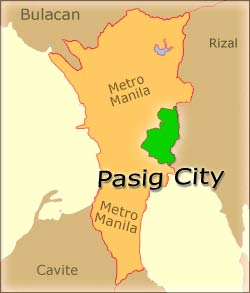 Located on the southeastern tip of the great river of lore and legend after which it was named, Pasig City is bounded on the west by Mandaluyong City and Quezon City; on the east by the Municipality of Cainta; on the south by Makati City, Taguig City and Pateros; and, on the north by Marikina City.
Bodies of water nurture life and civilization because it provides for man’s food and quenches his thirst, facilitates his mobility and irrigates his fields. In the early days, the Pasig River was teeming with life not only beneath its cool crystalline waters but along its fertile banks as well where flourishing settlements have taken root. Pasig City residents who are native to the area are Tagalogs who trace their roots to settlers from Cainta and Taytay and other neighboring eastern towns that thrived even before the coming of the Spanish colonists. These early settlers called themselves “taga-ilog,” which generally means “river people,” and was later contracted to “Tagalog.” Most ancient cultural centers of the Tagalog regions were founded on river banks or near the delta where the mouth of the river meets the sea. Present day Tagalogs refer to a cultural group in areas covering Regions III, IV and the National Capital Region who spoke a language on which Filipino is now based.
Determining the origin of the city’s name invariably required sifting through the many stories and legends surrounding the mighty Pasig River after which it was named. The most persuasive theory was advanced by Dr. Jose Villa Panganiban a noted linguist and former director of the Institute of National Language who stated that the word “pasig” is an ancient Sanskrit term that referred to a “river that flowed from one body of water to another.” Such is the case of Pasig River, which made it an important travel route from Laguna de Bay to Manila Bay. Because of their strategic locations, riverine communities like Manila and Pasig were centers of trade and commerce in pre-Hispanic Philippines, but it was also precisely because of this that they were the focal points of military interest and conflicts. While the river bustled with activity, life in the community that sprawled beside it was pleasant, idyllic and serene.
Because of its excellent location and access to major transport routes such as the Pasig River and the EDSA beltway, presence of adequate facilities and utilities, vital infrastructures and a bottomless supply of skilled and literate workforce, this once bucolic town is now one of the country’s fastest rising commercial and industrial cities in Metro Manila. The boom started with the establishment of the Asian Development Bank headquarters in the city followed by other financial institutions and multinational companies. What was once a lush green landscape is now a horizon of skyscrapers, huge malls and commercial complexes such as Ortigas Center, a fast growing business district that is giving the Ayala Center in Makati a run for its money. Today, Pasig City offers a healthy mix of business, recreational and leisure experience to visitors as it slowly regains its past glory of being the hub of trade and commerce of Metro Manila.
Even while the city hums with commercial and industrial activities, its attractions offer the visitor some quite and engaging moments to look back and reflect on a colorful time of its past when the city was young and life was easy and carefree.
Tiendesitas: Located along Ortigas Avenue at the corner of C5 Road, this novelty shopping complex with a unique Maranao architectural design is a must-see attraction for visitors. True to the spirit of its name, which means “little stores,” Tiendesitas is a 3-hectare village composed of 450 shops selling products from all over the Philippines. Here, you would find everything under the sun from delicious specialty food, clothing and fashion accessories to antiques and souvenir items and even pets. For the tired and hungry shopper, there is even a huge area within the complex that provides inexpensive meals and entertainment by performers on stage. To complete the rustic, native ambiance, a horse carriage ride gives the visitor the option to go back in time. This is a place that you definitely would not want to miss during your trip to Pasig.
Doña Geronima’s Cave: Located in Barangay Pineda, this mysterious cavern continues to baffle residents and commuters in the area. Legend has it that a generous enchantress lived in this cave whose narrow passages led up the mountain where a mansion built for her by her loved one is located. This mystic cave and its enchanted resident has been the subject of an anecdote by the Philippine National Hero, Dr. Jose Rizal in his famous novel, “El Filibusterismo.”
Ang Bahay na Tisa: Located at the west end of P. Gomez Street in Barangay San Jose, this 162-year old stone house of Spanish architecture is owned by the Tech family and is often used as a venue for art shows and cultural forums. More important than its elegant design and robust build, this structure was a secret witness and passive participant in historic events that unfolded in the past. Within the 65-centimeter thick walls of this 500 square meter structure, Katipunan patriots held secret meetings during the Philippine Revolution against Spain and sheltered Filipino guerilla freedom fighters forty-five years later during the Japanese occupation of the country.
Barcino Gourmet: In this cozy little wine and tapas bar located at City Golf Plaza along Julia Vargas Avenue, you can eat and drink excellent wine for as long as you want just like the Spaniards do during their heyday in the country. Home cooked Spanish cuisine such as paella, callos and fabada come at a very reasonable price. On your next visit to Pasig, why not try its tapas and premium aged wine.
Heat: Situated in the swanky EDSA Shangri-la Manila Garden Way in Ortigas Center, this restaurant has 20 distinct open cooking theaters with chefs preparing specialties ala minute. Various stations laden with not too pricey Oriental and Western food will surely satisfy even the most fickle of taste buds. Salmon sa miso and lechon are just some of the recommended specialties for the first timer.
Paparazzi: If you are craving for Italian food, then why not try this joint located also at EDSA Shangri-la Manila whose traditional Italian dishes suits the Filipino palate quite well. You can start your course with Golden Scallop Salad then order the Manila Baby Lobster Linguine or other signature dishes such as fried calamari, grilled Portobello mushrooms or pan fried sea bass. You would think that the price of the food is a bit on the high side, but when you get to taste these specialties, you’d realize that they are worth the price on the menu.
For the visitor or the resident, Pasig City is a good place to stay in. Since the city plays host to business and financial activities, it must necessarily have premium quality yet very affordable hotels such as:
The Richmonde Hotel: Located at the very heart of Ortigas Center, this plush hotel is just a few minutes away from financial institutions, blue-chip corporations, premier academic institutions and shopping and recreational centers. With rates starting at USD90.00 or P3,600.00 converted at prevailing forex rates, guests are entitled to air conditioning, multi-function telephone system, cable TV, Internet connectivity, mini bar, hair dryer, coffee/tea maker, and alarm clock.
Website: http://www.richmondehotel.com/
21 San Miguel Avenue
Ortigas Center, Pasig City 1600
Metro Manila, Philippines
Astoria Plaza Suites: This 35-storey high rise hotel’s well-appointed rooms are just perfect for the business and leisure traveler wanting to be at the center of all things exciting and interesting in the city. With rates starting at USD83.00 or P3,320.00 converted at current forex rates, guests will enjoy air conditioning, two twin single beds or one queen sized bed, audio/ video entry phone, IDD/NDD telephone, DVD player, Cable TV, room safe, coffee/ tea maker and ref.
Website: http://www.astoriaplazasuites.com/
15 J. Escriva Drive
Ortigas Business District
Pasig City
Tel. No. (+632) 687-1111
Fax No. (+632) 910-0370
Stables Guesthouse: This B&B located in a gated, well-secured subdivision in the city is just right for budget travelers seeking accommodations just 15 minutes from the business district, commercial and shopping centers, malls and the MRT trains and major transport routes. With rates starting at P1,150.00, travelers are entitled to inside and outside living room, dining area, a small library, TV/music and home theater room, a full kitchen and automatic washing machine.
1 Kariktan St.,
Kawilihan Village
Bagong Ilog, Pasig City
Tel. Nos. (063)534-0963 or 671-4520
Manila to Pasig and Back: The Metro Rail Transit (MRT) is the fastest and most economical way to get from Manila to Pasig. Take a train bound for Quezon City at the MRT station in C.M. Recto Avenue. Get off at the MRT station in Cubao and hop into another train bound for Makati. Alight at the MRT station in Shaw Blvd. in Mandaluyong then just cross EDSA to get to the Pasig side of the Ortigas Center. The entire trip should take less than one hour and will cost less than P50.00. Alternatively, you can ride on a jeepney from T.M. Kalaw in Manila with a Quiapo signboard. Get off at Quiapo and flag another jeepney with a Pasig signboard. The jeepney rides should cost not more than P50.00.
Cebu to Pasig and Back: To reach Pasig from Cebu, you can either fly from Cebu to the Manila Domestic Airport in Pasay or sail from Cebu to Manila. Approximate cost of a round trip plane ticket is P4,000.00 – P5,000.00 while a round trip boat fare is approximately P3,000.00 – P4,000.00. If you disembark at the Manila Domestic Airport, you can hop into a taxi cab or take the jeepney to the MRT station in Baclaran and board the train bound for the Shaw Blvd. station in Pasig. If your point of disembarkation is the Pier Area in Manila, you can ride on a jeepney or cab to the LRT-1 station in Rizal Avenue then take the train going to Baclaran in Parañaque. Once there hop on the train going to Shaw Blvd. station in Pasig. The taxi fare from the Pier Area to the LRT-1 station should cost you only about P100.00-P150.00, while the jeepney ride will be cheaper at P7.50 (one way). The train tickets, on the other hand, are less than P50.00.
Dumaguete to Pasig and Back: To reach Pasig from Dumaguete, you can fly from Dumaguete to the Manila Domestic Airport in Pasay City. From the airport, flag a taxi cab or a jeepney bound for the MRT station in Baclaran then board the train going to Shaw Blvd. in Pasig. Approximate cost of a round trip plane ticket is P4,000.00 – P5,000.00. The taxi fare will cost about P150.00 while the train ride to Pasig City is less than P30.00.
]]> https://dumagueteinfo.com/other-destinations/metro-manila/pasig-city/feed/ 1 Parañaque City: Novena Mecca of Metro Manila https://dumagueteinfo.com/other-destinations/metro-manila/paranaque-city-novena-mecca-of-metro-manila/ https://dumagueteinfo.com/other-destinations/metro-manila/paranaque-city-novena-mecca-of-metro-manila/#respond Tue, 16 Sep 2014 19:42:40 +0000 https://dumagueteinfo.com/PhilippinesTravel/metro-manila/paranaque-city-novena-mecca-of-metro-manila/13/ Parañaque
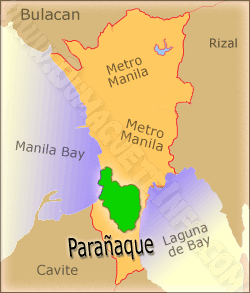 A thriving city of 4,770 hectares located about 8 kilometers south of the City of Manila, Parañaque is bounded by Las Piñas City in the southwest, Muntinlupa City in the southeast, Pasay City in the north and Boulevard 2000 of the reclaimed area of Manila Bay in the west.
Like many cities surrounding Manila, the history of Parañaque dates back to pre-Hispanic times when the early inhabitants of the place, which had access to the sea, actively traded with Malayan, Indonesian, Indian and Chinese seafarers. In 1572, the town of Parañaque was founded and inhabited by an industrious people engaged in weaving, slipper and shoe-making, salt-making, fishing and planting rice. It was then known as Palanyag, which means “my beloved,” describing the affection of its people to their town.
There are many anecdotes on how the present name of this city derived. But the most logical assumption is that, as different people migrated into this flourishing town, its name was gradually adulterated resulting into the word “palanyague” which later was corrupted into “Parañaque”. True enough, only ten percent of its population is native to the area, the rest is a mixture of migrants from the different regions of the Philippines and from other countries as well who have come to love the city and its potential for growth. Parañaque today is a melting pot of cultures and races.
There are so many things for the visitor to see and learn from a bustling city with a culture and history as varied and colorful as Parañaque that it would fill a book. For want of space, these have been condensed to the following places, events and activities that are a “must see” for the visitor who wants to have a glimpse of a cross section of the city’s cultural heritage.
The Redemptorist Church in Baclaran: This is the most visited and well-attended church in Asia because it is the Shrine of Our Lady of Perpetual Help. It is widely believed by many devotees here and abroad that their fervent petitions will be granted through the intercession of Our Lady of Perpetual Help, and that a novena rarely fails to result in the granting of the petition. On June 28, 1948, the first novena was celebrated at the shrine.
Ten years later, in 1988, the Redemptorist Fathers who run the shrine constructed and consecrated a more spacious church to accommodate up to 12,000 people. Since then, it has always remained open and every Wednesday, thousands of devotees from all over Metro Manila and from outlying provinces journey to hear mass and pray their novena at the shrine located in a city that has become known as the “Novena Mecca of Metro Manila.”
City Events: The people of Parañaque celebrate with aplomb numerous annual events that are steep in their historical and religious beliefs. The “Araw ng Palanyag,” or “Parañaque Day,” celebrated on February 15 kicks off city-wide events such as the Sambalilo Festival, Regatta de Palanyag and stage plays like the Komedya or Moro-Moro. During the Lenten Season, the people of the city observe the following with a solemnity rarely seen in other places outside the city: The Linggo ng Palaspas, or Palm Sunday; the Pasyon, or chanting of Christ’s life, passion, death and resurrection; Sinakulo, or Way of the Cross; and, Salubong, or Easter Vigil. This week-long religious event culminates with the celebration of the Holy Mass followed by the “Sayaw ng Pagbati,” or “Welcome Dance” rendered by all the barangays.
During the merry month of May, the “Flores de Mayo,” a procession of the city’s fairest ladies and offering of flowers to the Blessed Virgin is held after nine days of prayers, or novena. The “Sunduan,” which dramatizes an old courtship custom of a gentleman fetching her lady love to escort her home seems to reflect the romantic nature of the city’s residents. But in a deeper sense, this custom is a metaphor of the Blessed Virgin’s ascension to heaven accompanied by her son, Jesus Christ. The “Caracol,“ also held during the month of May highlights a lengthy procession to celebrate the Feast of Sta. Rita de Cascia, the patron saint of Baclaran.
Bulungan sa La Huerta: Literally translates to “whispers in La Huerta.” Bulungan sa La Huerta is therefore not a place name but rather a description of an activity in La Huerta, where the freshest fish catch from other parts of the country are landed. At dawn or late afternoon, when the catch is brought to port, fish retailers from Manila markets converge to this place and haggle for wholesale purchases. The buyer negotiates the purchase by whispering to the seller to keep his price offer or bid unknown to other buyers bidding for the same lot of fish catch.
‘Dampa’ sa Parañaque: This well-known place in the city located along Ninoy Aquino Avenue in Barangay San Dionisio began as a cluster of shacks, or ‘dampa,’ that offer cheap home-cooked food. Today it has grown into a complex of restaurants and stalls selling fresh sea food. Within this complex, you can buy fresh king crabs, lobsters, tiger prawns, shrimps, oysters, mussels and fishes and bring these to any of the restaurants where they will cook the sea food in any which way you like for a service fee of USD1.00, or P40.00 per dish. While waiting for your food, you can sip on a frosty mug of the world famous San Miguel Beer as you watch the world go by. For P1,500.00, a group of five would be able to feast on a sumptuous sea food meal at Sharmila’s, the most popular restaurant at ‘Dampa.’ If you are not on a strict diet, by all means—go to this place and have the culinary experience of your life.
Toho Restaurant Antigua: If you love big servings of Chinese food that comes with a bill that won’t even put a dent on your wallet, then check out this joint located at 16 President’s Avenue, Sucat, Parañaque.
Las Paellas Café: Farther up the road at 63 President Avenue, you will find this classy establishment that offers just about the best tasting authentic Spanish cuisine in these parts. While the food is quite pricey, it’s worth the experience to try out their Callos or Kare-kare cooked Iberian style.
Rodello’s Bed and Breakfast: Your accommodations in the city need not be expensive, especially if you intend to be out the whole day seeing the sights or enjoying the nightlife. With rates starting at USD35.00, or P1,400.00, this B&B inn is specifically targeted at backpackers, business travelers, tourists and even families seeking fun at affordable cost.
Website: http://www.rodellos.com/aboutbnb.htm
Moonwalk Subdivision,
Parañaque City
Tel. No.: (632) 776-9576
E-Mail: bnb@rodellos.com
El Grande Hometel Inn: This charming bungalow inn is ideal for young tourists, backpack travelers and visitors who would like to enjoy the comforts of a quiet, air conditioned home-style bedroom with private toilet and bath at the most affordable rates. Room rates start at rock bottom P700.00 per day.
344 El Grande Avenue, BF Homes
Sucat, Parañaque City
Tel. Nos. (632) 825-7524 or 827-5345
Fax No.: (632) 411-2311 or 376-2233 both telefax
The Manila Airport Hotel: If you are looking for an elegant place to stay with world standard rooms that is centrally located from the airport, Duty Free shops and Casino, then this is just the place for you. With rates starting at P2,398.00, you can enjoy five-star amenities, great service and excellent security.
Website: http://airporthotelmanila.com
Ninoy Aquino International Airport 1 Complex
Parañaque City
Tel. No.: (632) 854-7549
Fax No.: (632) 854-7550
Manila to Parañaque and Back: The Light Rail Transit (LRT-1) is the fastest and cheapest way to get from Manila to Parañaque. From its station in Monumento, the LRT traverses the Rizal Avenue Ext. in Caloocan going to the City of Manila all the way up to Baclaran in Parañaque City in less than thirty minutes for less than P30.00
Cebu to Parañaque and Back: To reach Parañaque from Cebu, you can either fly from Cebu to the Manila Domestic Airport in Pasay or sail from Cebu to Manila. Approximate cost of a round trip plane ticket is P4,000.00 – P5,000.00 while a round trip boat fare is approximately P3,000.00 – P4,000.00. If your point of disembarkation is the Pier Area in Manila, you can take a jeepney or cab to the LRT-1 station in Avenida Rizal and board the train going to Baclaran in Parañaque. The taxi fare from the Pier Area to the LRT-1 station is about P100.00-P150.00, while the jeepney fare is cheaper at P7.50 (one way). The LRT train fare is less than P30.00.
Dumaguete to Parañaque and Back: To reach Parañaque from Dumaguete, you can fly from Dumaguete to the Manila Domestic Airport in Pasay. Approximate cost of a round trip plane ticket is P4,000.00 – P5,000.00. Then, you can hop into a jeepney, bus or taxi cab and take that very short trip to Parañaque just a few hundred meters away from the airport.
]]> https://dumagueteinfo.com/other-destinations/metro-manila/paranaque-city-novena-mecca-of-metro-manila/feed/ 0 Marikina https://dumagueteinfo.com/other-destinations/metro-manila/marikina/ https://dumagueteinfo.com/other-destinations/metro-manila/marikina/#respond Sun, 14 Sep 2014 04:47:17 +0000 https://dumagueteinfo.com/PhilippinesTravel/manila/marikina/4/ Marikina: The Shoe Capital of the Philippines
 A 2,150-hectare land located in a fertile valley bounded by mountain ranges and bisected by a river, Marikina is one of the five municipalities and twelve cities that comprise Metro Manila on the island of Luzon, the biggest island in the Philippines. It is about 21 kilometers from the heart of the City of Manila. It is bounded on the east by the Sierra Madre mountain ranges and Antipolo City; on the west by the Quezon City hills; on the north by the Municipality of San Mateo; and, on the south by Pasig City and the Municipality of Cainta.
When the Spanish friars arrived in 1630, the place was established as a “pueblo,” and in 1637 it became a parish known as Mariquina, which was officially changed to Marikina by the Americans in 1901. Its lush farms and rice lands produced great quantities of rice and vegetables. But eventually, farming gave way to the shoemaking industry, which was started by Don Laureano “Kapitan Moy” Guevara in 1887. On December 8, 1996, this fast-growing municipality became a city. Because of the quality footwear it produces, the city has become known as the “Shoe Capital of Philippines.”
What to see in Marikina
This shoe capital of the country has its own share of attractions to offer. Heritage houses, historic churches and galleries vie for the attention of history and cultural buffs. Modern entertainment, sports, recreational facilities and parks are available. Cultural festivals such as the Rehiyon-rehiyon, Angkan-angkan and Marikina Christmas festivals are well-attended by foreign and local tourists alike. Among the city’s many attractions, the following are the most popular:
Sentrong Pangkultura ng Marikina: Located along J.P. Rizal Street in Barangay San Roque, this 200 year old building was once owned by “Kapitan May” himself, the acknowledged father of the shoe industry, and who designed and hand-made in 1887 within this heritage site the first ever pair of shoes in Marikina. Inside this edifice is the interesting Doll Museum, whose dioramas depict the history and cultural heritage of the city.
Shoe Museum: Also located along J.P. Rizal Street, this edifice was built in the 1860s and was used as an arsenal by the Spanish colonialists. At the closed of the Philippine-American War in the 1900s, this historic place was used to house the detention cell of General Sakay, one of the last Katipunan leaders. In 1998, this heritage site was turned into the Shoe Museum that showcased 800 pairs of the shoes belonging to the former First Lady, Imelda Marcos.
Our Lady of the Abandoned Church: This place of worship located along J.P. Rizal Street was built by the Augustinian friars in 1700s and destroyed by two earthquakes that occurred in 1816 and 1880 and was gutted by a fire in 1891. In 1963, this famous landmark underwent a series of renovations that restored this heritage place to its former glory.
The World’s Largest Pair of Shoes: Certified as the largest pair of shoes in the world by the Guinness Book of World Records, this tourist attraction can be found at the Shoe Gallery of the Riverbanks Mall located along the banks of the Marikina River in Barangay Barangka.
The aforementioned tourist destinations are just a few minutes from the City Hall, which lies at the heart of the city. These can easily be reached by cab, jeepneys or tricyles which abound along the main road where these tourist spots are located. Expect to pay only the minimum regular fare duly approved by the government for the commuting public.
Where to Eat in Marikina
Marikina is known for the culinary delights that its inhabitants whip up during fiestas. Some of these special dishes which mirror the culture of the city are featured at very reasonable prices in a couple of restaurants in the heart of the city right. Right along J.P. Rizal Street, you will find Aling Salud Panciteria, which serves the best noodles and whose specialty of the house is Pinagulong na Pancit (noodles rolled in oil and sauce). If you are looking for a wider food entrée, try Kusina ni Kambal, which also sits along the same street. This well-known restaurant is known for its yummy but reasonably priced Lumpiang Hubad.
However, if you are sightseeing west of the Marikina River, in Barangay Barangka, just a few hundred meters from the Marikina-Quezon City boundary, perhaps, you may want to walk into the Rivergrill Restaurant and Music Bar located in the Riverbanks Mall and have a taste of its grilled specialties. Less pricey chow is also available in fast food chains inside the mall such as Chow King, Tropical Hut and Jollibee. But if you are on the eastern side of the city and are looking for a place to eat, you may want to step into one of the many fast food chains and restaurants scattered inside the ultra modern Marquinton Plaza Mall just three minutes away from the City Hall.
Where to Stay in Marikina
Most major hotels in Metro Manila have established themselves in the bigger cosmopolitan cities of Makati, Manila, Quezon City, Pasig and Pasay. With the rapid urbanization of Marikina during the recent decade, this bustling shoe capital was is just about the only city east of Metro Manila that was able to put up a couple of tourist quality hotel accommodations that are reasonably priced.
The Marikina Hotel: Located along Pio del Pilar corner Tangerine Streets in Barangay Conception, this facility has 75 spacious fully air conditioned rooms that  meet the basic needs of guests traveling on business or leisure. With rates starting at USD 33.00+ or about P1,400.00 at current exchange rates, guests will enjoy the following basic amenities: single or pull out beds, separate shower and comfort rooms, hot and cold shower, 80 channel cable television, NDD/IDD telephone access and coffee/ tea maker.
Website: http://www.marikinahotel.com/
Pio Del Pilar Street – corner Tangerine Street
Brgy. Concepcion II – Marikina City
Phone: +632 998 8342 to 45
Fax: +632 998 8341
Riverbend Hotel: Located at Bonifacio Avenue, Riverbanks Center in Barangay Barangka, hotel rates start at P1,705.00. It has fully air conditioned rooms with cable television and telephone, conference room, wedding and banquet facilities, swimming pool and parking facilities. If you dig ballroom dancing and shopping in the nearby Riverbanks Mall, then this is the place for you.
Riverbend Hotel
Riverbend Center
84 A Bonifacio Avenue
Marikina City
Phone: +632 948 006
How to get to Marikina
How to get from Manila to Marikina and Back: There are two approaches to Marikina from Manila City Hall. The first is through the Magsaysay Avenue-Aurora Boulevard route via Ayala Bridge and the second is through the Quezon Boulevard-Espana-E. Rodriguez Avenue route via Quiapo Bridge. The modes of transportation plying both routes are buses, jeepneys and cabs. A portion of the Magsaysay Ave.-Aurora Blvd. route is service by the Metro Rail Transit system starting from the Legarda Street-C.Recto Avenue junction in Manila all the way up to Katipunan Avenue in Quezon City. From there, you can hop into a jeepney, bus or cab that will take you to the country’s shoe capital. The fare for any combination of jeepney, bus or MRT is approximately P30.00 (one way), while a cab ride from Manila will cost you somewhere in the vicinity of P300.00 to P500.00 (one way) taking into account the notorious Metro Manila weekday traffic.
How to get from Cebu to Marikina and Back: To reach Marikina from Cebu, you can either fly or sail from Cebu to Manila then take a bus or cab to your final destination. Approximate cost of round trip plane ticket is P3,500.00 – P5,000.00 while a round trip boat fare is about P3,000.00 – P4,000.00. After you disembark at the Manila Domestic Airport or Pier area, you can take a cab, which will cost about P300.00 to P500.00 (one way). If you are not in a hurry, from your point of disembarkation, you can hop on a bus, jeepney or MRT which will take you to the famous shoe capital for less than P30.00 (one way).
How to get from Dumaguete to Marikina and Back: To reach Marikina from Dumaguete, you can fly from Dumaguete to Manila then take a bus or cab to Marikina. Approximate cost of round trip plane ticket is P3,500.00 – P5,000.00. After you disembark at the Manila Domestic Airport, you can take a cab to Marikina, which will cost about P300.00 to P500.00 (one way). But if you have less money and more time to spend, you can hop on a bus, jeepney or MRT which will take you to Marikina for less than P30.00 (one way).
]]> https://dumagueteinfo.com/other-destinations/metro-manila/marikina/feed/ 0